Today, I went to Outlet, where the parking lot is connected to the shopping center. The shopping center has deliberately built a barrier-free passage to help people with disabilities or mobility problems. Previously, Outlet’s parking lot needed to be walked and staired to the shops. Now with this passage, more disabled people and people with reduced mobility can make shopping more convenient.
The design of the trash can on our campus is very unique, allowing different people to identify the type of garbage that can be placed in each trash can at the first time. Since the three types of trash cans have three different opening designs, the remaining types of garbage cannot be placed in the specific one (for example, the water bottle cannot be placed in the paper recycling bin). This design not only reduces the time people throw garbage, but provides more convenient help for people with different disabilities.
I walked to the front of the campus today and saw the design of the school badge. After some thoughts and photos, I found that our school’s badge design really considered the accessibility. The design of the school badge not only ensures that the text and background colors have high contrast but also uses a relatively large font size. Under the name of the school, the school’s website has also been added, so that the passing people can see at a glance.
Today, Professor MJ introduced us to the process of using compulsory electronic devices by the MasterChef champion Christine Ha. I have a lot of feelings that want to share with others. As a blind person, Christine has more problems in her life than our normal people, but she has overcome and been the first blind champion in the history of MasterChef kitchen. The electronic devices used in her life are also an important tool to help her career. The Voice Over function that comes with the Apple system applies the interaction between the device and the disabled. This system can read the text quickly, which is very helpful for blind people to use electronic devices.
Shopping in the downtown, the most difficult problem to solve is that I want to go to the restroom but I can’t find it, maybe I’ve already found a washroom but has no space for me. I accidentally discovered that the design of a toilet actually considered the use of disabled people. There are handrails for people to use on the side of the toilet and sink, and there is a little space for placing the wheelchairs. I hope that there will be more restrooms like this for people to use in Toronto in the future.
On this bright Saturday, I took a bus to the Scarborough Town Centre Shopping Mall. I found that the TTC’s bus station facilities in Scarborough Town Centre are very convenient for people with disabilities. Not only are there automatic doors for people with disabilities, but also elevators for people to go up and down, as well as ticketing systems with voice navigation. I can deeply understand that the decoration of this station is perfect considering the design of the accessible environment.
Instead, the gates in the opposite direction of the station entrance are leading to the coach station and GoBus station. This is a door that must be pulled by hand to open. Passing through this door is a very steep stair. Such a design often brings great operational difficulties to people with mobility impairments who come by public transport.
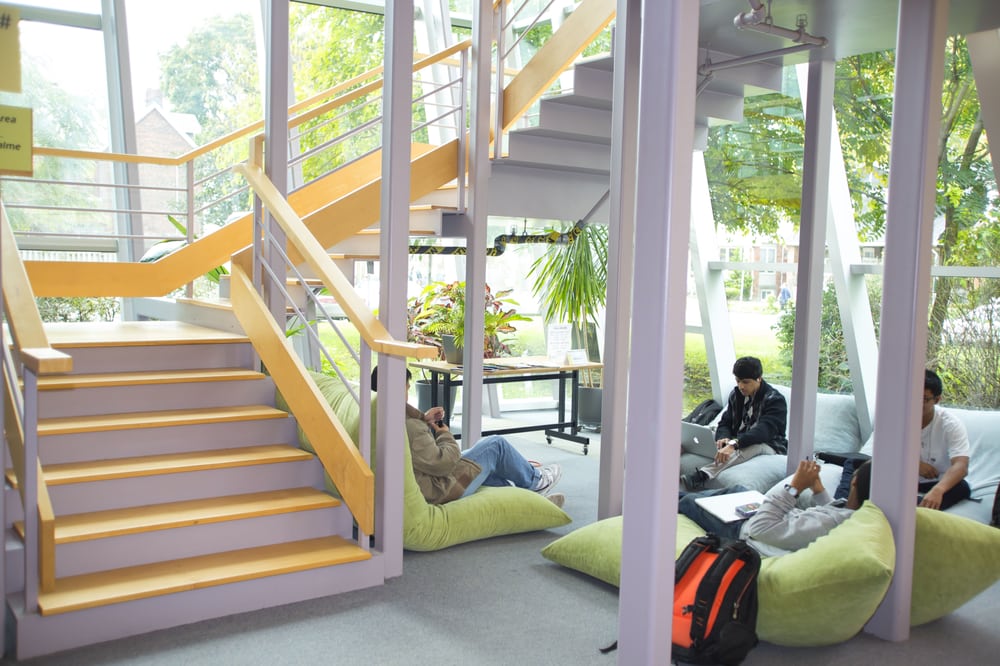
Today, walking in the lobby of the campus, I want to find a place to rest for a while, then I found that the chairs on the first floor of the school are very high, which may be very unfriendly for a person with height disabilities. Even the tall boys of my classmates and I have to tiptoe to get on the chairs. Going to the second floor and the library, I found that all the sofas were very short. It might be difficult for a person with visual impairment to sit down. I think the school needs to pay more attention to the design concept of the accessible environment in terms of seats.
After coming to school today, I found that the central stairway of the school was designed to make it easy for people using wheelchairs to go up and down the stairs. The stairs are connected by two slow ramps. Most of the students who come to the second floor of the class choose to use this way to go upstairs.
Until I saw a student using a wheelchair going upstairs on this ramp, I thought this ramp is a good barrier-free design for the disabled. However, I saw that student was pushing the wheelchair, then I realize that it was not a good accessible design. The slope was so steep that the school deliberately hanged a notice prohibiting the wheelchair from using the ramp.
Today, I walked in the art and story building. While looking up, I found that at the end of each corridor and at the intersection, there will be a spherical mirror that allows people to observe pedestrians from different directions. I have never paid attention to those details, but it will bring great help to people with disabilities. They can observe in advance whether there is a pedestrian passing in the direction of the dead corner to respond in time.
On the first day of the semester, I found a new change from the first moment I entered the school gate – our campus changed the new ‘accessible’ automatic door open button. The previous buttons needed to be pressed to open slowly, but now people only need to gently wave your hand to achieve the same result. This design provides a more accessible environment for students with disabilities who come to school.




 Observation of Accessibility / Usability in Everyday Life